Saturday, October 28, 2023

9.10.22.3. Protection around Cooktops

 9.10.22.3. Protection around #Cooktops


Because of the risk of #stovetop fires, combustible wall framing, #finishes and #cabinets within 450 mm (17 3/4 in.) of the area where a gas or electric cooktop is to be located must be protected above the level of the heating elements or burners by a material providing #fire resistance at least equivalent to that provided by 9.5 mm (3/8 in.) thickness of gypsum board (see Figure 9.10.-42). #Counter-top splash boards and back plates are exempted from this requirement.

Quoted from Illustrated Users' Guide - NBC2015


Saturday, October 21, 2023

Unprotected Openings (NBC Article 9.10.14.4.) and Glazed Openings (NBC Article 9.10.15.4.)

 Unprotected Openings (NBC Article 9.10.14.4.) and Glazed Openings (NBC Article 9.10.15.4.)


NBC Subsection 9.10.14. uses the term “unprotected opening.” It means any #opening other than one equipped with a #closure having the required fire-protection rating, or any part of a #wall forming part of the exposing building face that has a fire-resistance rating less than that required for the exposing building face. Unprotected openings include windows, #doors and openings for #electrical and #mechanical services.

NBC Subsection 9.10.15. uses the term “glazed opening.” Glazed openings include windows and glazed portions of doors. The area of glazed openings is measured to the rough opening of the window or door, not to the edges of the #glazing.

The area of unprotected or glazed openings allowed on a building face is based on the distance from an exposing building face to a property line, the centre line of a #street or public thoroughfare, or an imaginary line between two buildings or two fire compartments on the same #property (Figure 9.10.-26).

Quoted from Illustrated Users' Guide -- NBC2015
#unprotectedopening #glazedopening #fireprotection #exposingbuildingface #fireresistancerating #roughopening #propertyline #firecompartment


Saturday, October 14, 2023

9.10.19.3. Location of Smoke Alarms

 9.10.19.3. Location of Smoke Alarms


A smoke alarm is not required on each level in a #split-level dwelling unit given that each level does not count as a separate #storey. However, where the sleeping areas are on two levels of a single storey in a split-level #dwelling unit, an additional smoke alarm must be installed so that both areas are protected (Figure 9.10.-41).

Quoted from Illustrated Users' Guide -- NBC2015
#smokealarm #dewellingunit #buildingcode


Saturday, October 7, 2023

How are plans reviewed?—#013

 How are plans reviewed?—#013


Signs of no service:

The #AHJ didn't provide service, If you got a Building Plans Review #Report from the AHJ with more than 10 permit conditions,  but none of which was related to your #plans, or if your building permits were approved without being asked to provide any #drawings.


Review plans and conduct field #inspections are the key services the AHJ should provide to the building permit #applicants.  However, some people like the money, but are not willing to provide #service.

#permitconditions #buildingpermit


Thursday, October 5, 2023

9.10.19.3. Location of Smoke Alarms

 9.10.19.3. Location of Smoke Alarms


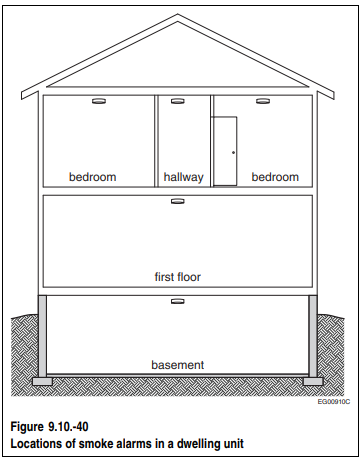
This Article indicates where smoke alarms are required in dwelling units. Since the prime purpose of a smoke alarm is to wake the sleeping #occupants in the #suite in which the fire originated, smoke alarms are installed in each #bedroom and in the #hallway that serves them. To avoid any delay in warning due to the time it takes for #smoke to travel from #storey to storey, and to allow for the fact that other habitable rooms can be used for #sleeping, additional smoke detectors must be installed on other storeys, including #basements.


A smoke alarm installed in the living area and wired to sound another smoke alarm located near bedrooms is the ideal solution (Figure 9.10.-40).


Quoted from Illustrated Users' Guide -- NBC2015

#smokealarm #dwelingunit #smokedetector


Thursday, September 28, 2023

9.10.16.2. Required Fire Blocks in Wall Assemblies

 9.10.16.2. Required Fire Blocks in #Wall Assemblies


#Furring or #strapping can also create spaces that allow fire spread. These should also be blocked off at each #floor level and at the #ceiling level if the ceiling #membrane provides part of the required fire resistance (Figure 9.10.-38). Since furring can be installed either horizontally or vertically, both the horizontal and vertical spacings of fire blocks are limited (20 m (65 ft. 7 in.) and 3 m (10 ft.), respectively).

Quoted for Illustrated Users' Guide - NBC2015
#fireblock #fireresistance


Wednesday, September 27, 2023

Sunday, September 24, 2023

9.10.16.2. Required Fire Blocks in Wall Assemblies

 9.10.16.2. Required Fire Blocks in Wall Assemblies


Concealed spaces in #walls should not interconnect with concealed spaces above or below them. Coved #ceilings that can create pathways between the wall space and either #floor spaces or #attic spaces should be fire blocked at the bottom of the cove to prevent communication between the horizontal and the vertical spaces (Figure 9.10.-37).

Quoted from Illustrated Users' Guide - NBC2015
#fireblock #concealedspace


Saturday, September 16, 2023

9.10.16.2. Required Fire Blocks in Wall Assemblies

 9.10.16.2. Required Fire Blocks in Wall Assemblies


This Article indicates where fire blocking is required in #walls. Wall assemblies that have concealed spaces greater than 25 mm (1 in.) in depth created by #furring and spaces between the #studs require fire blocks every 3 m (9 ft. 10 in.) vertically and every 20 m (65 ft. 7 in.) horizontally, unless the exposed construction materials within the space are #noncombustible, have a flame-spread rating of not more than 25, or are filled with #insulation. The value of the flame-spread rating of the combustible materials determines the permitted extent of the concealed space between fire blocks. The materials to be considered include all construction materials regulated by the NBC, including the framing and building services that are located in the concealed space. 

In balloon frame construction where the stud spaces are continuous through two or more storeys, the spaces between the studs have to be blocked off at each level to restrict fire spread (Figure 9.10.-36).

Quoted from Illustrated Users' Guide - NBC2015
#fireblock #concealedspace #flamespreadrating #wallassemblies #balloonframe


Sunday, September 10, 2023

9.10.16.2. Required Fire Blocks in Wall Assemblies

 9.10.16.2. Required Fire Blocks in Wall Assemblies


This Article indicates where fire blocking is required in #walls. Wall assemblies that have concealed spaces greater than 25 mm (1 in.) in depth created by #furring and spaces between the #studs require fire blocks every 3 m (9 ft. 10 in.) vertically and every 20 m (65 ft. 7 in.) horizontally, unless the exposed construction materials within the space are #noncombustible, have a flame-spread rating of not more than 25, or are filled with #insulation. The value of the flame-spread rating of the combustible materials determines the permitted extent of the concealed space between fire blocks. The materials to be considered include all construction materials regulated by the NBC, including the framing and building services that are located in the concealed space.

In #platform frame construction, many of these requirements are met as a result of normal framing practices. This is illustrated in Figure 9.10.-35.

Quoted from Illustrated Users' Guide - NBC2015
#fireblock #concealedspace #flamespreadrating #wallassemblies


Read Article 3.2.2.81 below and answer question:

  Do I need to provide a fire-resistance rating for a mezzanine under this Article? 3.2.2.81, Group F, Division 2, up to 2 Storeys, Sprinkle...