Saturday, March 16, 2024

9.10.13.13. Fire Dampers

 9.10.13.13. Fire Dampers


This Article provides requirements for devices that enable #ducts penetrating a fire separation to be closed in the event of fire, so as to prevent fire spread across a fire separation. In most cases, a duct that penetrates an #assembly required to be a fire separation with a fire-resistance rating needs to be equipped with a fire damper.

Where a duct passes completely through a rated fire separation, it provides a potential #passageway for fire and hot gases. To maintain the integrity of the separation, a fire damper is usually required in the plane of the separation. This device is also required to have a fire-protection rating. It is normally held in the open position by a #fusible link, and is installed so that it will stay in place if the duct collapses (Figure 9.10.-19). The fusible link and damper must be accessible for #testing and #inspection.

#firedamper #fireseparation #fireprotectionrating #fusiblelink


Saturday, February 24, 2024

Structural Considerations

 Structural Considerations


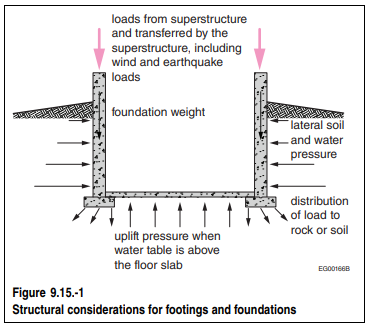
Foundations carry their own weight and the #loads transferred to them from the #superstructures they support to the ground. Vertical loads include the weight of the superstructure itself (dead load) and that of its occupants and contents (live load) in combination with the roof snow load. #Wind and #earthquake loads must also be resisted by the #foundation.

Where foundations extend into the ground and enclose space such as #basements and crawl spaces, they must also adequately resist lateral #soil and #water pressures acting against them. Foundations should not #settle significantly or unevenly over time. They should remain unaffected by the #freezing and #thawing of soils, and #moisture expansion and contraction in the soil.

Quoted from Illustrated Users' Guide - NBC2015
#deadload, #liveload, #snowload, #windload, #earthquakeload, #crawlspace


Sunday, January 28, 2024

Common strategies used to direct water away from building foundations

 Common strategies used to direct water away from building foundations


#Rainwater and #snow-melt that do not drain away from a #foundation and into a #drainage system will seep into the soil next to the foundation. If the water cannot percolate downward quickly through the soil to a level below the footings, the soil can become saturated and can even create #hydrostatic pressure against the foundation and beneath the floor. This can cause leakage into the #basement or crawl space.
#crawlspace

Quoted from Illustrated Users' Guide -- NBC2015


Saturday, January 20, 2024

9.13.3.1. Required Waterproofing

 9.13.3.1. Required Waterproofing


Where #hydrostatic pressure occurs, assemblies separating interior space from the ground must be #waterproofed. #Roofs of underground structures must also be waterproofed. 

Hydrostatic pressure occurs when the #groundwater table rises above building assemblies. #Drainage systems, which are required around the base of #footings, eliminate hydrostatic pressure on the assemblies above as long as the footings are below the water table. However, footing drains can become ineffective if they are blocked or have an inadequate capacity. Certain sites tend to be wet and poorly drained because of #topography or soil conditions; as a result, when #snow melts or during periods of heavy rain, below-grade spaces may be subjected to hydrostatic pressure. #Walls and #floors subject to hydrostatic pressure from a high water table must be designed to resist such pressure.

Quoted from Illustrated Users' Guide - NBC2015


Saturday, January 13, 2024

9.13.2.5. Moisture Protection for Interior Finishes

 9.13.2.5. Moisture Protection for Interior Finishes 


Excess water from #cast-in-place #concrete and ground moisture tends to migrate toward interior spaces, particularly in the spring and summer. Where moisture-susceptible materials, such as #finishes or #wood members, are in contact with #foundation walls, the moisture needs to be controlled by installing a moisture barrier on the interior surface of the foundation wall that extends from the underside of the interior finish up the face of the wall to a point just above the level of the ground outside. 

The reason the moisture barrier on the interior surface of the foundation wall must be stopped near ground level is to allow any moisture that finds its way into the finished wall #cavity from the interior space (through leaks in the air or vapour barrier) to diffuse to the exterior. If the vapour #permeance of #dampproofing membranes or coatings exceeds 170 ng/(Pa·s·m2) (3 perm), the moisture barrier may be carried full height. If their #vapour #permeance is less than 170 ng/(Pa·s·m2) (3 perm), there is a risk of #moisture being trapped on the interior surface of the moisture barrier. The permeance limit corresponds to the lower limit for breathable building membranes, such as asphalt-impregnated #sheathing paper.
 
Quoted from Illustrated Users' Guide - NBC2015
#moisturebarrier #foundationwall #interiorfinish #sheathingpaper


Saturday, January 6, 2024

9.13.2.4. Application of Dampproofing Material

 9.13.2.4. Application of Dampproofing Material 


1) Exterior #dampproofing shall be applied from finished #ground level to the top of the exterior of the #footing. 

2) Unless otherwise stated in this Subsection, dampproofing shall be installed in accordance with the manufacturer’s instructions with regard to
 
a) surface #priming, 
b) conditions during application, 
c) application quantity and rate, and 
d) #curing times. 

3) #Joints, #cracks and #penetrations shall be sealed to maintain the continuity of the dampproofing, where the dampproofing material is not capable of bridging such discontinuities.

Quoted from Illustrated Users' Guide -- National Building Code 2015


Tuesday, December 26, 2023

9.13.2.1. Required Dampproofing

 9.13.2.1. Required Dampproofing


This Article indicates where #dampproofing is required. Dampproofing is applied to #foundation walls to seal the small #pores that are always present in #concrete and #parging to reduce the #capillary water migration through concrete, parging and masonry block. Dampproofing does not provide #waterproofing, and should not be confused with waterproofing 

Quoted from Illustrated Users' Guide - NBC2015


Saturday, December 23, 2023

The control of moisture

 The control of moisture


There are four sources of #moisture associated with #foundations:


(1) surface water, 

(2) soil moisture,

(3) groundwater, and 

(4) construction materials moisture. 


Surface #water from #rain and #snow-melt is controlled through the use of #eavestroughing and #grading


Soil moisture, in the form of water or water #vapour, is controlled by #dampproofing materials and #drainage.


Where the #groundwater table is high enough to cause hydrostatic pressure against the foundation, it is controlled by #waterproofing combined with a structural design capable of resisting water pressures. 


Construction moisture, principally water in concrete, is best controlled by allowing adequate #curing and drying time before enclosing.


Quoted from Illustrated Users' Guide - NBC2015


Sunday, December 10, 2023

The Control of Moisture

 The Control of Moisture


The control of #moisture transfer through #foundations is needed to prevent damage to the interior finish material and #basement contents, and to protect the long-term integrity of the #building structure. The measures that are used to control moisture transfer through foundation walls are also intended to control indoor #humidity levels and contribute to the reduction of soil gas and #radon entry into #basements, thereby contributing to a healthy interior environment.

#soilgas

Quoted from Illustrated Users' Guide - NBC2015


Sunday, December 3, 2023

9.12.4.1. Support of Footings

 9.12.4.1. Support of Footings 


This Article addresses #trenching below the #footing that is required for services. It requires that the soil in the trench be compacted by tamping to the footing base, or be filled with concrete having a strength of at least 10 MPa (1 400 psi), as illustrated in Figure 9.12.-8.

Quoted from Illustrated Users' Guide - NBC2015


Read Article 3.2.2.81 below and answer question:

  Do I need to provide a fire-resistance rating for a mezzanine under this Article? 3.2.2.81, Group F, Division 2, up to 2 Storeys, Sprinkle...